517
517Ferromagnetic Resonance (FMR) is a captivating occurrence rooted in the world of physics. It arises when an external magnetic field acts upon a ferromagnetic material, inciting particular atomic particles within to oscillate at a unique frequency. This frequency, determined by the interplay between the external field and the material's inherent qualities, is directly linked to the alignment of magnetic moments.
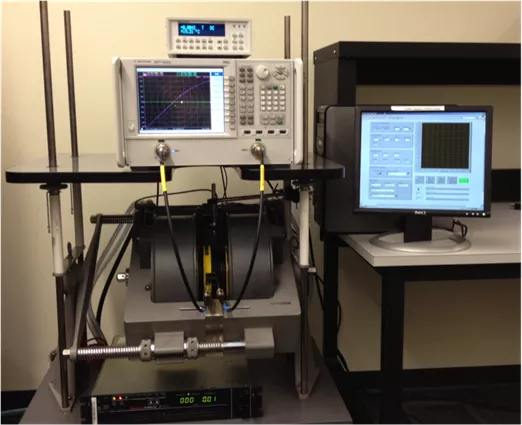
These magnetic moments and their intricate interactions are the core focus of FMR. By leveraging this phenomenon, scientists can explore the fascinating world of magnetic moments in greater depth. This exploration has led to a multitude of applications, spanning various fields, solidifying FMR's relevance and importance in contemporary research.
This section delves into the historical journey of FMR, discussing the early research, key contributors, and recent advancements that have shaped our modern understanding of ferromagnetic resonance.
The principle of FMR was first observed in the early 20th century, with initial research focusing on understanding the magnetic behaviors of various materials. These early observations laid the groundwork for the development of FMR theory.
Notable scientists like Isidor Rabi and Felix Bloch made significant contributions to the understanding of magnetic resonance, which eventually led to the development of FMR theory. Their work in nuclear magnetic resonance (NMR) provided foundational knowledge for the field.
Recent advancements in FMR theory include the exploration of spin dynamics and spin wave theory, as well as the development of new techniques to measure and analyze FMR.
In this section, we will explore the fundamental principles and mechanics of FMR. Covering its working theory, the role that external magnetic fields play, and the conditions required for resonance.
The theory behind FMR involves the alignment of magnetic moments within a ferromagnetic material. These moments process, or wobble, around their equilibrium position when subjected to an external magnetic field. The frequency of this precession depends on the strength of the magnetic field and the characteristics of the material.
External magnetic fields play a crucial role in FMR, as they cause the magnetic moments to align and process. The strength of this external field determines the resonance frequency, making it a critical factor in FMR studies.
Resonance occurs when the frequency of the external magnetic field matches the precession frequency of the magnetic moments. This condition is known as the resonance condition and is essential for observing FMR.
This section outlines the methodologies and experimental setups employed in FMR studies while incorporating the newest, cutting-edge techniques in the field.
The typical experimental setup for FMR studies involves the use of a microwave source, a magnet to produce the external field, and a detector to measure the absorption of microwaves.
Common techniques include broadband FMR and vector network analyzer FMR. These techniques offer different advantages, such as a wide frequency range or the ability to measure both amplitude and phase of the resonance.
Recent advancements include the development of spatially resolved FMR techniques and the use of ultrafast laser pulses to induce FMR, providing greater insight into the dynamics of magnetic moments.
Here we examine the broad-ranging applications of FMR, from its use in advancing material science and technology to its application within the medical field.
FMR is widely used in material science to study the magnetic properties of materials, providing essential information for the development of new magnetic materials.
FMR finds applications in technology and electronics, particularly in the design of magnetic storage devices and spintronic devices.
While not as common, FMR also has potential applications in medical science, such as magnetic resonance imaging (MRI) and magnetic particle imaging (MPI) for diagnostic purposes.
Current research in Ferromagnetic Resonance (FMR) is focused on exploring new materials, particularly those with unique magnetic properties, and improving measurement techniques to provide clearer, more accurate data.
The integration of FMR with nanotechnology is ushering in a new era of miniaturized, high-precision devices that could revolutionize various fields including data storage and biomedical applications.
Furthermore, as quantum technologies evolve, FMR is expected to play an even more significant role. Quantum systems often require precise control of magnetic interactions, a realm where FMR excels.
Future perspectives involve using FMR to better understand quantum coherence and entanglement in magnetic systems.
The challenge lies not only in theoretical advancements but also in the development of experimental tools capable of probing these quantum phenomena in ferromagnetic materials.
Now you know that Ferromagnetic Resonance (FMR), a key tool in understanding magnetic properties, impacts various fields including technology and medical imaging. Its advancing techniques promise enhanced material exploration and the potential for new technologies. FMR remains a vibrant, influential field with untapped potential.

Disclaimer: The views and opinions expressed by individual authors or forum participants on this website do not represent the views and opinions of Chipsmall, nor do they represent Chipsmall's official policy.

share this blog to:


Chipsmall will provide you real-time product updates, limited-time deals.


Copyright © 2004-2026 Chipsmall.com All Rights Reserved.

Feedback
We appreciate your engagement with Chipsmall's products and services. Your opinion matters to us! Kindly take a moment to complete the form below. Your valuable feedback ensures that we consistently deliver the exceptional service you deserve. Thank you for being part of our journey towards excellence.