834
834Have you noticed how some devices are good at doing certain jobs quickly and smoothly? Like how your phone shows clear graphics, or how big machines mine cryptocurrency super fast? Behind that speed is a special chip called an ASIC chip. It’s made to do just one job, but it does that job extremely well.
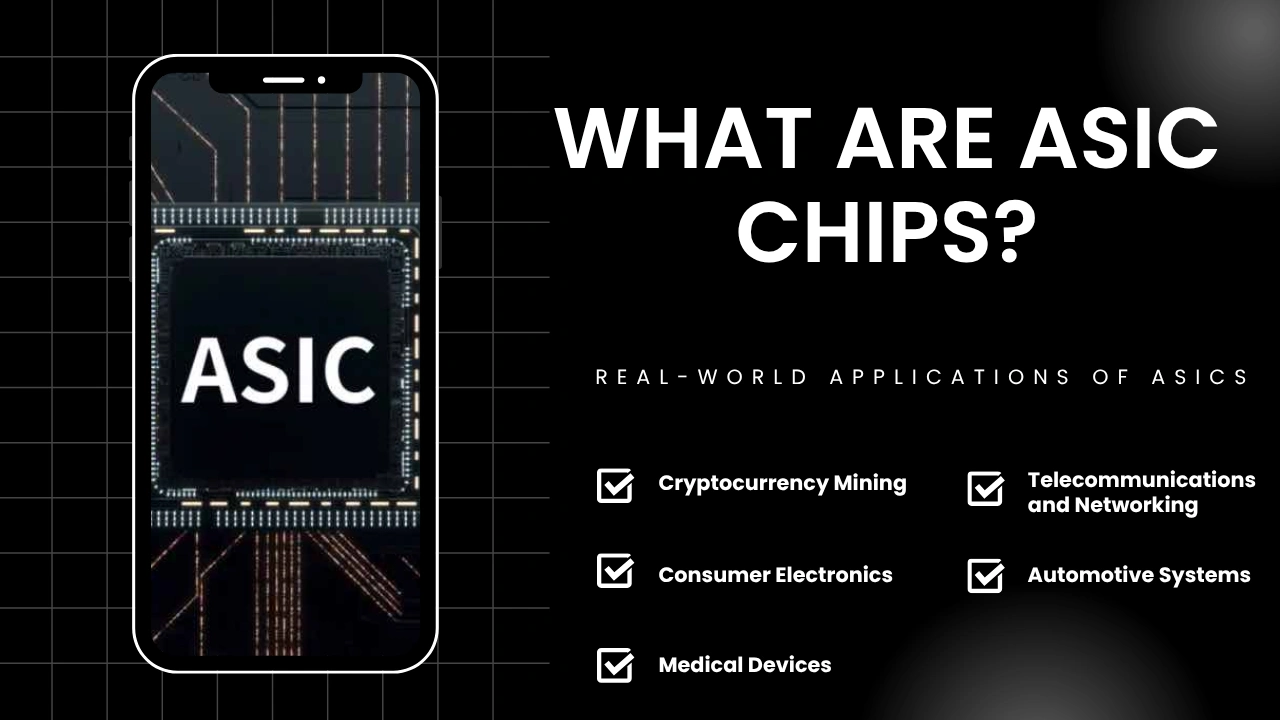
An ASIC is a custom-designed chip built for a specific application or task. Unlike general-purpose chips (like CPUs), which can run various software programs, ASICs are hardwired to perform one specific job extremely efficiently.
For example, Bitcoin mining ASICs are optimized solely for solving cryptographic hash functions—no more, no less. This level of specialization makes them faster, more energy-efficient, and more cost-effective for the tasks they’re designed to handle.
The history of ASICs dates back to the early 1970s. In 1974, Robert Lipp developed the first CMOS gate array, laying the groundwork for modern ASIC design. However, the ASIC revolution truly took off in the 1980s when companies like VLSI Technology and LSI Logic began developing computer-aided design (CAD) tools to simplify chip customization.
As manufacturing techniques improved, ASICs became more powerful, smaller, and cost-effective. These advancements made them indispensable for companies seeking high-performance hardware with reduced energy consumption.
ASICs are essentially compact systems made up of millions (or even billions) of transistors and logic gates. These components are arranged in a way that allows the chip to perform a specific digital function.
Once designed and fabricated, an ASIC executes its intended task with incredible speed and efficiency. Not like CPUs or GPUs, which can be programmed to do many things, ASICs cannot be reprogrammed after manufacturing, making them faster but inflexible.

Designing an ASIC is a complex, multi-step process that involves:
Defining the Functionality: Engineers decide exactly what the chip needs to do.
Writing HDL Code: Hardware description languages like Verilog or VHDL are used to model the chip’s behavior.
Simulation and Verification: The design is tested in software to catch errors before production.
Synthesis and Layout: The HDL code is translated into a physical layout using CAD tools.
Fabrication: The chip is manufactured using photolithography at specialized semiconductor foundries like TSMC or GlobalFoundries.
Packaging and Testing: After fabrication, the chip is packaged and tested to ensure functionality and performance.
ASICs can be classified into three main categories:
Full-Custom ASICs: These chips are built from the ground up, offering maximum optimization. They provide the best performance and efficiency but come with high development costs and long design times. They’re used in products where performance is mission-critical, like advanced AI processors or high-speed networking equipment.
Semi-Custom ASICs: Semi-custom ASICs use pre-designed components (like standard cells or gate arrays) with custom wiring. This strikes a balance between customization and development speed, making them more affordable and easier to design.
Programmable ASICs (FPGAs): Though not technically ASICs, FPGAs are often grouped here. They allow users to configure the chip after fabrication. FPGAs are ideal for testing, research, and low-volume production, but they lag behind true ASICs in terms of efficiency and speed.
Application-Specific Integrated Circuits (ASICs) are transforming the way industries approach efficiency, performance, and specialized computing. Designed to perform a single task with optimal precision, ASICs offer significant advantages over general-purpose chips, including faster processing, lower energy use, and reduced system complexity.
Here are some of the most impactful real-world applications of ASICs.
Cryptocurrency Mining: ASICs are the backbone of modern cryptocurrency mining. In networks like Bitcoin, which use proof-of-work consensus mechanisms, mining speed and energy efficiency are critical for profitability. ASIC miners are specifically engineered to execute hashing algorithms, such as SHA-256, at lightning-fast speeds. These chips are fine-tuned to perform the same calculation millions of times per second. This specialization allows for significantly better hash rates and energy efficiency, making ASICs the preferred solution for serious miners and mining farms.
Consumer Electronics: You might not see them, but ASICs power many functions in your smartphone, tablet, smart TV, and gaming console. For example, smartphones use ASICs for facial recognition, camera image processing, fingerprint scanning, and audio enhancement. These chips work behind the scenes to offload specific tasks from the main CPU, improving responsiveness and battery life. In gaming consoles, ASICs are often responsible for advanced graphics rendering or handling real-time AI behavior, helping deliver seamless, immersive gaming experiences.
Artificial Intelligence and Machine Learning: Artificial Intelligence (AI) demands immense computing power, and ASICs are stepping up to meet that demand. Companies like Google have developed custom ASICs known as TPUs (Tensor Processing Units), which are specifically built to accelerate deep learning workloads. These chips are optimized to handle complex mathematical operations used in neural networks, such as matrix multiplications and convolutions. As a result, ASICs can process AI tasks more efficiently than CPUs or even GPUs, enabling faster training and inference in AI applications like voice recognition, predictive analytics, and autonomous systems.
Telecommunications and Networking: In the fast-paced world of telecommunications, ASICs play a vital role in ensuring fast and reliable data transmission. Routers, modems, and 5G base stations depend on ASICs to process data packets, manage network traffic, and perform signal encoding/decoding. Their speed and efficiency reduce latency and power consumption, two critical factors in maintaining smooth communication networks. ASICs also support secure encryption algorithms, helping protect sensitive data during transmission across the internet or cellular networks.
Automotive Systems: Modern vehicles are packed with technology, and many of their smart features rely on ASICs. Advanced Driver-Assistance Systems (ADAS), which include functions like automatic braking, lane-keeping, and collision avoidance, use ASICs to quickly process input from cameras, radar, and other sensors. Additionally, ASICs control essential systems such as engine performance, battery management in electric vehicles, and infotainment displays. These chips are built to withstand the harsh conditions of automotive environments, such as temperature extremes and vibrations, while delivering real-time performance.
Medical Devices: ASICs are essential in the medical field, where precision and reliability are non-negotiable. Portable diagnostic devices like glucose meters, ECG monitors, and blood pressure cuffs use ASICs to ensure accurate and consistent measurements. Implantable devices such as pacemakers and defibrillators also rely on these chips due to their compact size and ultra-low power requirements. In hospital-grade equipment, ASICs contribute to faster data processing and real-time monitoring, improving patient outcomes and supporting efficient healthcare delivery.
Industrial Automation: Factories and industrial settings are becoming increasingly automated, and ASICs are helping drive that change. These chips are used in robotics, motor controllers, and process control systems to enable real-time data processing and precision control. ASICs ensure that machinery operates with optimal timing and energy usage, reducing downtime and improving safety. Whether it’s monitoring conveyor belts, managing electrical loads, or detecting system faults, ASICs are essential for modern industrial efficiency.
Defense and Aerospace: In high-stakes environments like defense and space exploration, ASICs are trusted for their reliability and performance. They are used in radar systems, satellite communications, missile guidance, and encrypted data links. These chips must endure extreme conditions such as radiation, temperature swings, and vibration. Radiation-hardened ASICs are often employed in spacecraft to maintain functionality in space. Because missions in these sectors are mission-critical, ASICs are rigorously tested to ensure zero failure rates.
|
Advantages
|
|
Disadvantages
|
When it comes to sourcing authentic ASIC chips, choosing a reliable supplier is crucial. One well-known distributor is Chipsmall. They specialize in providing original and high-quality electronic components, including ASICs.

Chipsmall is based in Hong Kong and works with trusted brands like Microchip, TI, and NXP. Their focus is on real, quality parts and helpful service, not fancy promises. When you’re working on a project, it’s good to have a supplier you can trust.
If you’ve ever had to hunt down a rare or outdated electronic component, you’ll understand why a company like Chipsmall matters. Whether you're working on large-scale projects or developing specialized devices, Chipsmall is your dependable component partner.
Q1. What makes ASICs more efficient than general-purpose processors?
A: ASICs are specifically designed to perform one task extremely well. This allows for optimized performance, reduced power consumption, and smaller physical size compared to general-purpose processors, which are built to handle a wide variety of functions.
Q2. How long does it take to design and manufacture an ASIC?
A: The entire ASIC development process—from defining functionality to fabrication—can take anywhere from six months to over a year, depending on complexity. Full-custom ASICs take longer due to extensive design and verification steps.
Q3. Are ASICs only used in large-scale commercial products?
A: While ASICs are often used in high-volume applications to justify development costs, they are also used in specialized equipment like medical devices, aerospace systems, and research tools where performance and reliability are critical.
Q4. How do companies verify that an ASIC design is error-free before production?
A: Engineers use simulation and verification tools to test the digital logic using HDL code (like Verilog or VHDL) before any physical chip is produced. This helps catch errors and optimize performance before costly fabrication.
Q5. What industries benefit most from ASIC technology?
A: Industries like cryptocurrency mining, AI and machine learning, telecommunications, automotive, and consumer electronics benefit significantly from ASICs due to their speed, power efficiency, and compact design.
Q6. Why are ASICs considered less flexible than FPGAs or CPUs?
A: ASICs are hardwired during manufacturing, meaning their function is fixed and cannot be changed later. In contrast, FPGAs and CPUs can be reprogrammed or updated, making them more adaptable to evolving tasks or algorithms.
ASICs are the hidden heroes behind much of the tech we rely on. Whether it’s your smartphone camera snapping perfect shots, your car’s safety features keeping you on track, or the lightning-fast servers powering AI apps, there’s probably an ASIC making it all happen.
They’re custom-built for one job, and they do it well. That means faster performance, lower energy use, and more compact devices. Designing and building an ASIC can be expensive and time-consuming, but in industries where speed, efficiency, and reliability are everything, the payoff is worth it.
They may not make headlines, but ASICs are more than just tiny chips—they’re the silent engines driving the future of technology.

Disclaimer: The views and opinions expressed by individual authors or forum participants on this website do not represent the views and opinions of Chipsmall, nor do they represent Chipsmall's official policy.

share this blog to:


Chipsmall will provide you real-time product updates, limited-time deals.


Copyright © 2004-2026 Chipsmall.com All Rights Reserved.

Feedback
We appreciate your engagement with Chipsmall's products and services. Your opinion matters to us! Kindly take a moment to complete the form below. Your valuable feedback ensures that we consistently deliver the exceptional service you deserve. Thank you for being part of our journey towards excellence.