436
436Voltage regulators play a critical role in nearly every electronic circuit. Whether you're building a power supply for a microcontroller, an amplifier, or a mobile device, a voltage regulator ensures your system receives a consistent, stable voltage. In this guide, we’ll explore why we use voltage regulators, their pros and cons, how to choose the right one, and a list of the top 10 voltage regulator ICs for power supply design.

Voltage regulators are essential for managing voltage levels in electronic systems. Power from batteries or power adapters is often unstable or mismatched with the requirements of electronic components. A voltage regulator stabilizes that input to prevent malfunction or damage.
Know more about voltage regulators>> Voltage Regulator: Types&Working Principles
Stable Output Voltage: The primary advantage of a voltage regulator is that it delivers a consistent output, regardless of variations in input voltage or load conditions.
Component Protection: Voltage regulators help protect sensitive components from voltage spikes or dips.
Improved Performance: Stable voltage allows electronics to operate efficiently and as intended.
Simplicity: Many voltage regulator ICs are easy to integrate, reducing design complexity.
Versatility: Available in linear and switching types, voltage regulators can be used for a wide range of applications.
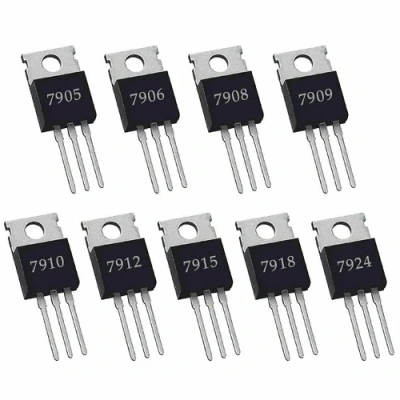
Power Dissipation: Linear voltage regulators can generate significant heat, especially when the input voltage is much higher than the output.
Lower Efficiency: Compared to switching regulators, linear regulators are less energy efficient.
Size and Complexity: Switching voltage regulators, while efficient, can be more complex and require additional external components.
Cost: High-performance regulators can be more expensive, particularly for high-current or high-voltage applications.
One of the most popular voltage regulator ICs is the LM7805, a linear voltage regulator that outputs a fixed 5V. It’s been widely used for decades in hobbyist and industrial applications. However, with the increasing demand for energy efficiency, switching voltage regulators like the LM2596 and MP1584 have also gained popularity.
Today’s market includes hundreds of voltage regulators, each optimized for different needs—low-dropout (LDO) regulators, buck converters, boost converters, and more.
A number of important factors must be taken into account when selecting a voltage regulator:
Input and Output Voltage: Verify that the regulator can supply the required output voltage and supports your input voltage.
Output Current: Align the maximum output current of the regulator with the amount of load you need.
Efficiency Requirements: For straightforward, low-power applications, use linear regulators. For applications requiring high efficiency, use switching regulators.
Dropout Voltage: To minimize the voltage differential between the input and output of battery-powered devices, select an LDO regulator.
Package Type: Verify that the form factor satisfies your thermal and PCB design specifications.
Noise Sensitivity: Use low-noise LDOs for analog circuits that are sensitive.

Here’s a list of the top 10 voltage regulator ICs trusted by engineers around the world. These regulators are known for performance, reliability, and availability.
Texas Instruments / STMicroelectronics
A fixed 5V linear voltage regulator. Known for its ease of use and robustness, it’s ideal for general-purpose electronics and prototyping.
Advanced Monolithic Systems
A popular low-dropout linear regulator, commonly used in Arduino and Raspberry Pi accessories. It provides a clean 3.3V or 5V output.
Texas Instruments
An adjustable linear regulator that can output between 1.25V to 37V. It’s great for custom voltage needs with moderate current requirements.
Monolithic Power Systems
A highly efficient buck converter that supports a wide input voltage range. Perfect for compact, power-sensitive designs.
Analog Devices
A precision LDO regulator with the unique ability to be paralleled for higher output current. Ideal for noise-sensitive and high-accuracy applications.
Texas Instrument
A high-performance, ultra-low-noise LDO used in audio, RF, and precision analog circuits where low ripple is essential.
Texas Instruments
A versatile step-down switching regulator with up to 3A output. Widely used in DC-DC converter modules available on the market.
Diodes Incorporated
A pin-compatible alternative to the AMS1117, used for 3.3V and 5V regulation. It’s frequently found in embedded systems and development boards.
Analog Devices
An advanced PMIC that integrates multiple regulators in a single chip, optimized for wearables and battery-powered IoT devices.
Texas Instruments
A 2A buck converter with good thermal performance and wide voltage input range. Excellent for industrial and automotive designs.
These voltage regulator ICs are widely available and cover both linear and switching categories, making them suitable for different power supply design requirements.
Discover high-quality voltage regulators for all your needs! We source and distribute products from leading manufacturers, ensuring reliability and performance. Visit us today to explore our wide selection and find the perfect solution for your application. Shop now for top-tier voltage regulators at competitive prices!
If the heat generated by the voltage regulator during operation cannot be effectively dissipated, it will lead to performance degradation or even permanent damage. Overheating problems are mainly caused by the following factors:
Excessive power loss
The efficiency of linear regulators (such as LDO) depends on the input and output voltage difference. The larger the voltage difference, the higher the power loss (Pd=(Vin-Vout)×Iout). For example, when the input is 5V and the output is 3.3V, the loss under 1A load is 1.7W. Without proper heat dissipation measures, the chip temperature will rise rapidly.
Inadequate heat dissipation design
Improper PCB layout, such as too small copper foil area, lack of heat dissipation vias
No heat sink or insufficient heat sink size
Excessive ambient temperature or poor ventilation
Solution:
Power supply noise can affect the performance of sensitive circuits, especially for analog circuits and RF systems. The noise mainly comes from:
Intrinsic noise of linear regulator
Noise of reference voltage source (1/f noise of bandgap reference)
Error amplifier noise
Thermal noise of feedback network
Ripple noise of switching regulator
Switching frequency and its harmonics (usually 100kHz-2MHz)
Inductor current ripple
Parasitic oscillation caused by PCB layout
Suppression measures:
Short circuit is one of the most serious faults in power supply system. Effective protection circuit can prevent equipment damage.
Classification of protection mechanisms:
Current limiting protection
Constant current limiting: For example, LM317 limits the output current to about 2.2A when short-circuited
Foldback current limiting: When short-circuited, the current drops to 20-30% of the normal value (such as LM7805)
Multiple protection strategies
Overtemperature shutdown: Automatically shut down when the junction temperature exceeds 150°C (most modern ICs are standard)
Hiccup Mode: Periodically try to restart to avoid continuous heating
MOSFET gate drive protection: Prevent direct conduction of upper and lower tubes
Design points:
In conclusion, voltage regulators are vital components in modern electronics, ensuring stability, safety, and efficiency in power management. Whether you choose a classic LM7805 or a high-performance buck converter like the MP1584, selecting the right voltage regulator IC can make or break your power supply design.
Understanding your voltage and current requirements, efficiency needs, and component compatibility is crucial when choosing a voltage regulator. Use this guide to find the best option for your project and stay up-to-date with the top-performing voltage regulator ICs in the industry.

Disclaimer: The views and opinions expressed by individual authors or forum participants on this website do not represent the views and opinions of Chipsmall, nor do they represent Chipsmall's official policy.

share this blog to:


Chipsmall will provide you real-time product updates, limited-time deals.


Copyright © 2004-2026 Chipsmall.com All Rights Reserved.

Feedback
We appreciate your engagement with Chipsmall's products and services. Your opinion matters to us! Kindly take a moment to complete the form below. Your valuable feedback ensures that we consistently deliver the exceptional service you deserve. Thank you for being part of our journey towards excellence.