559
559Every day, people send messages, make video calls, and stream movies from different corners of the world. This happens through long-distance fiber optic cables. These cables carry light signals that move fast and hold a lot of data. But there is one problem. When light travels over a long distance, it starts to lose its strength. This is called signal attenuation. If the signal becomes too weak, the data can get lost or arrive with errors.
Here’s where optical amplifiers come in. These small devices help boost the light signal without changing it into electricity first. That means no extra steps, no extra delays. The signal stays in its original light form. The result is fast and smooth communication over long distances.
Let's learn more about optical amplifiers, how they work, the different types available, and why they are important in fiber optic networks.
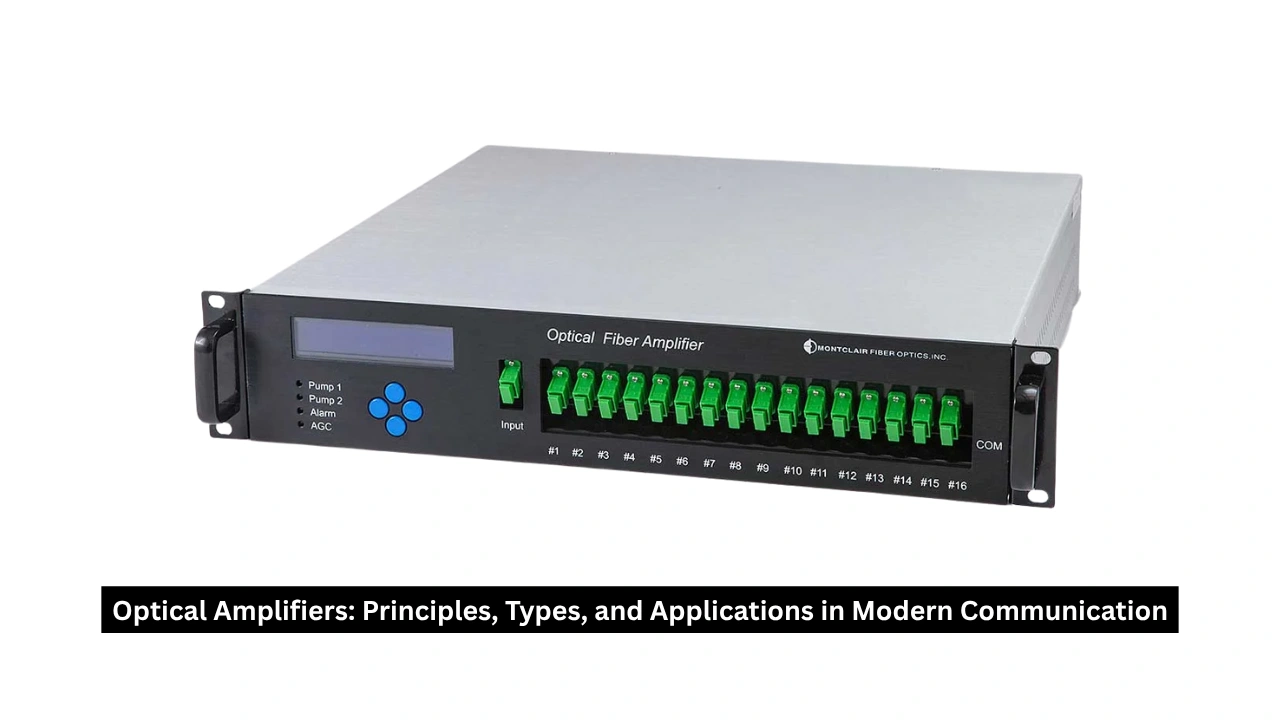
An optical amplifier is a device that increases the power of a light signal in a fiber optic cable. It does this without changing the light into an electrical signal.
In the past, systems used repeaters to fix weak signals. These repeaters turned light into electricity, boosted the signal, and then turned it back into light. This took more time, cost more, and added complexity.
Optical amplifiers work differently. They amplify the light directly, with no conversions. This process is faster, more efficient, and keeps the signal clearer.
Using optical amplifiers helps reduce signal distortion, lowers system costs, and supports long-distance communication. That’s why they are now a key part of modern fiber optic networks.

Optical amplifiers work through a process called stimulated emission. This means that when a weak light signal passes through a special material, that material adds more light to the signal. The added light matches the signal in both phase and wavelength, making the signal stronger without changing its shape.
1. Gain Medium: The gain medium is the heart of the amplifier. It’s usually made of special materials like erbium-doped fiber, semiconductors, or rare-earth ions. These materials can boost light when given enough energy.
2. Pump Source: The gain medium needs energy to work. This energy comes from a pump source, which can be another light (like a laser) or electricity. The pump raises the energy level of the atoms in the gain medium, getting them ready to amplify the signal.
3. Signal Pathway: The weak light signal enters the amplifier through a fiber or waveguide, passes through the gain medium, and leaves as a stronger signal. The input and output paths are usually aligned to keep the signal smooth.
Signal Input: A weak light signal carrying data enters the amplifier.
Pumping the Gain Medium: At the same time, the pump source sends energy into the gain medium. This energy excites the atoms inside.
Stimulated Emission: As the signal passes through, the excited atoms release extra light that matches the signal. This adds more power to the signal.
Signal Amplification: By the time the light leaves the amplifier, it is much stronger, but still has the same shape and data.
A simple flowchart can show this process clearly:
Signal In →
Pump Energy Added →
Stimulated Emission in Gain Medium →
Amplified Signal Out
This flow helps visualize how optical amplifiers make long-distance communication possible.
Erbium-Doped Fiber Amplifier (EDFA): The Erbium-Doped Fiber Amplifier (EDFA) is the most commonly used optical amplifier in fiber optic networks. It uses a special optical fiber doped with erbium ions as the gain medium. When this fiber is pumped with light at wavelengths like 980 nm or 1480 nm, the erbium ions get excited. As the weak signal passes through, the excited ions release extra photons through stimulated emission, amplifying the signal. EDFA works best at a wavelength around 1550 nm, which is ideal because this range has the lowest loss in standard silica optical fibers. This makes it perfect for long-distance data transmission. EDFA is widely used in the telecom industry, especially in submarine cables and high-capacity internet backbones, due to its low noise and high performance.
Fiber Raman Amplifier (FRA): The Fiber Raman Amplifier (FRA) works differently from EDFA. It does not use a doped fiber. Instead, it relies on a natural effect called Raman scattering, where light transfers energy to other light traveling in the same fiber. When a strong pump laser is sent through the transmission fiber along with the signal, it transfers energy to the signal light, boosting it. One key advantage of FRA is its broad amplification bandwidth. This means it can amplify signals over a wider range of wavelengths. FRA is also tunable, since changing the pump wavelength can shift the gain region. These features make it useful in Dense Wavelength Division Multiplexing (DWDM) systems, where many signals at different wavelengths are sent through the same fiber.
Semiconductor Optical Amplifier (SOA): The Semiconductor Optical Amplifier (SOA) is made from semiconductor materials such as Indium Gallium Arsenide Phosphide (InGaAsP). The design is similar to that of a laser diode, but SOAs are made to amplify incoming light instead of generating their own. SOAs are electrically pumped, meaning they are powered by electric current rather than another light source. These amplifiers are small and compact, which makes them easy to integrate with other devices on optical chips. They are often used in metro and short-haul networks, data centers, and optical switches where space is limited.
Other Types: Some other types of optical amplifiers include Tapered Amplifiers, which provide high output power and are often used in scientific setups. Brillouin Amplifiers work through Brillouin scattering, another nonlinear optical effect, and can be used in sensing applications. Optical Parametric Amplifiers (OPA) use nonlinear crystals to amplify signals and are often found in specialized applications such as ultrafast laser systems. These amplifiers are less common in communication networks but are important in research and advanced photonics systems.
Understanding how optical amplifiers perform involves looking at some important technical terms. These concepts help explain how well an amplifier works and what limits its performance.
Gain and Gain Saturation: Gain is the increase in signal power that an amplifier provides. It is usually measured in decibels (dB). But gain has a limit. When the input signal becomes too strong, the amplifier cannot add more energy. This is called gain saturation. After this point, the gain drops, and the output does not increase as much.
Saturation Power and Energy: Saturation power is the input power level at which gain starts to drop. Saturation energy is the total energy that the amplifier can give before it stops amplifying effectively. These limits help decide how much signal the amplifier can handle at one time.
Noise Figure and ASE: All amplifiers add some noise. The noise figure tells how much extra noise is added compared to an ideal amplifier. One major source of noise is Amplified Spontaneous Emission (ASE). This happens when the amplifier’s gain medium randomly releases photons. Too much ASE can harm signal quality.
Pump Power Efficiency: The pump power is the energy used to excite the gain medium. Efficiency refers to how well this pump energy is converted into signal amplification. Higher efficiency means better performance with less energy wasted.
Gain Bandwidth: Gain bandwidth is the range of wavelengths an amplifier can support. A wide bandwidth means the amplifier can boost many different signals at once. This is very useful in systems like DWDM (Dense Wavelength Division Multiplexing), where many channels are sent over the same fiber.
Single-mode vs. Multimode Operation: Some amplifiers are single-mode, meaning they only support one path or mode for light. Others are multimode, which can handle several paths. Single-mode is better for long-distance, high-quality transmission. Multimode can carry more power but may introduce more distortion.
Parasitic Lasing and Back-Reflections: Sometimes, stray reflections inside the amplifier cause unwanted parasitic lasing, or fake signals. Back-reflections can also lead to signal feedback, harming performance. Special components like isolators are often used to prevent these problems.
Optical amplifiers are used in many areas where fast and reliable communication is needed. They help boost signal strength without the need for electrical conversion, which saves time, cost, and space. Below are the major applications of optical amplifiers in today's technology.
Long-Haul Communications: In long-distance communication, like submarine cables and internet backbones, signals travel across thousands of kilometers. Over such distances, signal strength drops. Optical amplifiers are placed at intervals to keep the signal strong. This helps ensure smooth data flow across continents and under oceans.
Dense Wavelength Division Multiplexing (DWDM): DWDM systems send many data signals through the same fiber using different wavelengths. Optical amplifiers like EDFAs and FRA can amplify all these wavelengths at once. This is called simultaneous signal amplification. It allows faster internet speeds and higher data capacity without adding more cables.
Laser Systems (MOPA Configurations): In MOPA (Master Oscillator Power Amplifier) systems, a low-power laser signal (the master) is first generated. Then, it passes through an amplifier to increase its strength. Optical amplifiers in MOPA setups are used in laser machining, materials processing, and precision medical equipment.
Ultrafast Pulse Amplification: Some systems send ultrashort light pulses for things like spectroscopy, microscopy, or LiDAR (used in self-driving cars and environmental sensing). These pulses need to be powerful but short. Optical amplifiers increase their energy without changing the pulse shape, making them ideal for high-speed, high-accuracy work.
Fiber Optic Sensors & Satellite Links: Fiber optic sensors are used in oil pipelines, bridges, and other structures. Optical amplifiers help boost the signals in these systems, especially when they cover long distances. In satellite and space communication, signals must travel through space with very low power. Amplifiers help maintain signal quality in aerospace and defense applications.
Optical amplifiers are essential components in modern communication systems, and many companies specialize in designing and producing them. These manufacturers offer reliable and high-performance amplifiers for various applications, from telecom to research and aerospace.
MPB Communications: MPB Communications is known for its advanced erbium-doped fiber amplifiers (EDFAs) and Raman amplifiers. The company offers solutions for both terrestrial and submarine networks, and its products are widely used in long-haul and high-power applications.
Thorlabs: Thorlabs is a well-known name in the optics and photonics industry. It provides a wide range of fiber amplifiers doped with erbium, ytterbium, and praseodymium. These are available in benchtop or packaged modules for research labs, laser systems, and data communication.
Lumibird: Lumibird offers both continuous wave and pulsed fiber amplifiers. These are used in LiDAR, free-space communication, and remote sensing. The company also makes diode-pumped solid-state laser heads that serve as optical amplifiers in advanced applications.
RPMC Lasers: RPMC Lasers specializes in high-power amplifiers across different formats—fiber, semiconductor, and optical parametric amplifiers. Their amplifiers are used in industrial, aerospace, and research environments. Products are customizable for both OEM and lab use.
There are many reputable manufacturers and suppliers in the market. One of the top trusted names in electronic components is Chipsmall. It is known for supplying authentic, high-quality components and serves industries across Europe, America, and South Asia. If you're looking for a reliable source to buy optical amplifiers for telecom, research, or custom applications, Chipsmall offers a wide range of options and excellent support.
The world never stops communicating, and optical amplifiers are the quiet workhorses that keep signals strong, fast, and clear.
We've moved far beyond the era of signal regeneration that required complex optical-to-electrical conversions. Today, optical amplifiers boost data in its pure light form—without delay, distortion, or loss of integrity. That’s not just innovation—it’s a game-changer.
If you’re building, scaling, or future-proofing your network, remember: reliable communication starts with a reliable signal—and that begins with the right optical amplifier.

Disclaimer: The views and opinions expressed by individual authors or forum participants on this website do not represent the views and opinions of Chipsmall, nor do they represent Chipsmall's official policy.

share this blog to:


Chipsmall will provide you real-time product updates, limited-time deals.


Copyright © 2004-2026 Chipsmall.com All Rights Reserved.

Feedback
We appreciate your engagement with Chipsmall's products and services. Your opinion matters to us! Kindly take a moment to complete the form below. Your valuable feedback ensures that we consistently deliver the exceptional service you deserve. Thank you for being part of our journey towards excellence.