3733
3733In modern electronics, especially in high-power and high-frequency applications, MOSFETs (Metal-Oxide-Semiconductor Field-Effect Transistors) are widely used as switching devices. However, to fully utilize their performance, a dedicated circuit known as the MOSFET gate driver is often required. This article provides a complete guide to what a MOSFET gate driver is, how it works, why it is important, and where it is used in real-world applications.
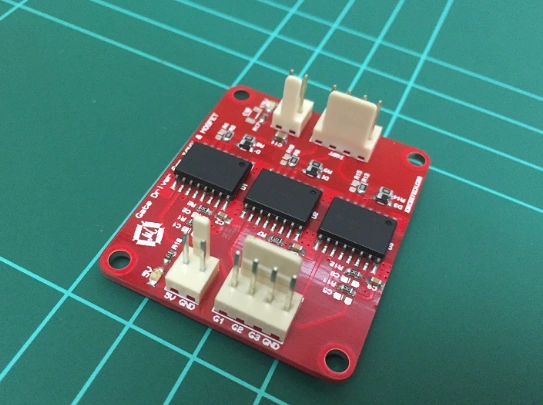
A MOSFET gate driver is an electronic circuit or IC (integrated circuit) designed to control the voltage and current applied to the gate terminal of a MOSFET. Since the MOSFET gate behaves like a capacitor, it requires a certain amount of charge to switch between the ON and OFF states.
A gate driver ensures that:
The MOSFET turns on quickly by supplying sufficient current to charge the gate capacitance.
The MOSFET turns off rapidly by discharging the gate.
By providing this function, gate drivers improve switching speed, reduce power losses, and protect the MOSFET from operating in inefficient regions.
MOSFETs are voltage-controlled devices, but in practice, the charging and discharging of the gate capacitance can be slow if only driven by a weak signal source such as a microcontroller. This leads to:
Increased Switching Losses – The MOSFET spends more time in the transition region (partially on), generating heat.
Electromagnetic Interference (EMI) – Slow switching creates unwanted noise in power circuits.
Gate Overvoltage or Undervoltage – Without proper driving, MOSFETs may fail to turn on fully, leading to inefficiency or even damage.
Therefore, a MOSFET gate driver acts as an interface between low-power control logic (e.g., microcontrollers, digital ICs) and the high-power MOSFET, ensuring fast, reliable, and efficient switching.
At its core, a gate driver operates like a buffer amplifier between the logic signal and the MOSFET gate.
Input Side: Accepts low-voltage signals (typically 3.3V or 5V from a microcontroller).
Output Side: Delivers higher voltage and current (10V–15V for N-channel MOSFETs) to rapidly charge/discharge the gate.
A simplified sequence:
When input is HIGH → the driver sources current into the MOSFET gate → MOSFET turns ON.
When input is LOW → the driver sinks current from the gate → MOSFET turns OFF.
Some advanced drivers also include level shifting (for high-side MOSFETs), protection features (UVLO, overcurrent), and dead-time control for half-bridge or full-bridge circuits.
MOSFET gate drivers come in several forms, depending on the application:
Low-Side Gate Drivers
High-Side Gate Drivers
Isolated Gate Drivers
When choosing a gate driver, engineers consider several critical specifications:
Supply Voltage (VDD): Determines the maximum gate drive voltage (often 10–15V for MOSFETs).
Peak Source/Sink Current: Defines how fast the driver can charge/discharge the gate. Higher current = faster switching.
Propagation Delay: Time taken for the driver to respond to input. Low delay ensures synchronized switching.
UVLO (Under-Voltage Lockout): Protects MOSFETs from insufficient gate drive voltage.
Rise and Fall Times: Affect efficiency and EMI performance.
MOSFET gate drivers are critical in many modern electronic systems, particularly where high efficiency and fast switching are required:
Switch-Mode Power Supplies (SMPS)
Gate drivers improve efficiency in DC-DC and AC-DC converters by ensuring fast MOSFET switching.
Motor Control Systems
Used in H-bridge or half-bridge motor drivers for robotics, drones, and electric vehicles.
Renewable Energy Systems
Solar inverters and wind turbine converters use isolated gate drivers for high-voltage MOSFETs.
Class-D Audio Amplifiers
Gate drivers switch MOSFETs at high frequencies to achieve efficient audio amplification.
Electric Vehicles (EVs)
Gate drivers are essential in traction inverters, onboard chargers, and battery management systems.
Faster Switching Speeds → Improved efficiency and lower heat dissipation.
Higher Power Handling → Enable MOSFETs to drive motors, power supplies, and inverters effectively.
Protection Features → Prevents gate overvoltage, under-voltage, and cross-conduction.
Compatibility → Interfaces easily between low-voltage logic and high-power stages.
Despite their benefits, MOSFET gate drivers also present some challenges:
Complexity → High-side and isolated drivers add design complexity.
Cost → Advanced gate drivers may increase overall circuit cost.
PCB Layout Sensitivity → Poor layout can cause ringing, EMI, and false triggering.
Thermal Management → High-frequency switching can generate heat that must be managed.
1. Do all MOSFETs need a gate driver?
Not always. Small MOSFETs in low-power circuits can be driven directly by microcontrollers. However, for high-power or high-speed switching, a gate driver is essential.
2. What is the typical gate drive voltage?
Most N-channel MOSFETs require 10–12V for full enhancement. Logic-level MOSFETs may work at 5V or lower.
3. What is the difference between a high-side and low-side driver?
A low-side driver references ground, while a high-side driver controls MOSFETs connected to the supply rail or switching node.
4. Can a MOSFET gate driver be used for IGBTs?
Yes. Many gate drivers can also drive IGBTs since they have similar gate charge requirements.
5. Where can I buy MOSFET gate drivers?
They are available from major suppliers such as Texas Instruments, Infineon, STMicroelectronics, and on marketplaces like Digi-Key and Mouser.
The MOSFET gate driver is a critical component that bridges the gap between low-power control circuits and high-power MOSFETs. By enabling fast and efficient switching, gate drivers improve performance in power supplies, motor drivers, renewable energy systems, and more.
For engineers and designers, understanding how gate drivers work, their types, and their key parameters is essential to creating efficient and reliable electronic systems. As technology advances—particularly in electric vehicles and renewable energy—the role of MOSFET gate drivers will only become more significant.

Disclaimer: The views and opinions expressed by individual authors or forum participants on this website do not represent the views and opinions of Chipsmall, nor do they represent Chipsmall's official policy.

share this blog to:


Chipsmall will provide you real-time product updates, limited-time deals.


Copyright © 2004-2026 Chipsmall.com All Rights Reserved.

Feedback
We appreciate your engagement with Chipsmall's products and services. Your opinion matters to us! Kindly take a moment to complete the form below. Your valuable feedback ensures that we consistently deliver the exceptional service you deserve. Thank you for being part of our journey towards excellence.