280
280An H-bridge is a simple circuit that lets you control a DC motor to go backward or forward. You normally use it with a microcontroller. When you can control two motors to go either forward or backward – you can build yourself a robot!
Imagine controlling the direction and speed of a tiny robot, powering the spinning wheels of a remote-controlled car, or even regulating the airflow of a fan. All these seemingly diverse tasks share a common hero: the humble H-bridge circuit.
So, what exactly is an H-bridge circuit?
Think of it as a powerful electronic switch specifically designed for controlling direct current (DC) motors. It acts like a bridge between a DC power source and the motor, cleverly manipulating the current flow to change the motor's direction and speed.
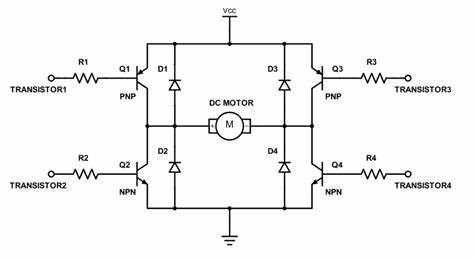
To understand how an H-bridge circuit works, let's break it down into its core components and functions:
The H-Bridge is a circuit that allows a DC motor to be driven in forward and reverse directions. It uses four transistors as solid-state switches to control the motor polarity
Imagine an "H" shape, where the horizontal lines represent the power source and motor, and the vertical lines represent four switches (transistors or an IC). The motor sits at the intersection of these lines, connecting to both sides of the "H."
Each switch acts like a gate, controlling the current flow from the power source to the motor. By strategically turning these switches on and off in specific combinations, the H-bridge manipulates the current path, achieving different effects:
In the discrete transistor method, each switch is a transistor controlled by logic signals. Turning a transistor "on" allows current to flow through it, while "off" blocks the current. By applying specific logic patterns to the transistors, the H-bridge controls the current flow to the motor.
In the integrated circuit (IC) method, a single chip encapsulates various transistors and control logic. You provide input signals to the IC, and it internally manages the individual transistors to achieve the desired motor control.
By understanding the "H" structure, switch control, and logic behind each method, you can grasp the essence of how an H-bridge operates. It's like a complex conductor, orchestrating the flow of electrical current to make the motor dance to its tune!
Remember, building and understanding H-bridges requires some electronics knowledge and safety precautions. If you're unsure or a beginner, start with simpler projects or pre-built modules until you feel comfortable working with electronics.
The main control methods for H-Bridges are approximate square wave, pulse width modulation (PWM), and cascaded multi-level control.
Approximate square wave has lower switching frequency but higher harmonics. PWM reduces harmonics as frequency increases, but has higher switching losses. Cascaded multi-level control minimizes harmonics without a filter, providing a sinusoidal output at lower switching frequencies.
H-bridge circuits, with their ability to control the direction and speed of DC motors, find themselves woven into the fabric of various applications across diverse fields.

2. Consumer Electronics:
3. Renewable Energy Systems:
The future of H-bridge circuits holds promise for even wider applications, constantly evolving with advancements in motor technology and control methods. Their potentials for innovation make them an essential tool for engineers and hobbyists alike, shaping the future of various industries.
One of the first steps in working with H-bridge circuits is testing them to ensure they are functioning correctly. To test an H-bridge circuit, you can use a multimeter to check the continuity of the connections. Make sure all the wiring is correct and there are no short circuits. You can also use a signal generator and an oscilloscope to test the input and output signals of the H-bridge.
H-bridge circuits come in various specifications, including the maximum voltage and current ratings, switching speed, and thermal resistance. It's essential to understand these specifications to ensure the H-bridge can handle the load you intend to drive with it. Additionally, consider the type of motor you will be controlling with the H-bridge, as this will also impact the specifications you need.
When choosing an H-bridge circuit, consider factors such as the voltage and current requirements of your application, the switching speed you need, and the size and cost of the H-bridge. It's also essential to consider the type of motor you will be driving, as different motors require different types of H-bridge circuits. Research different manufacturers and read reviews to find a reliable H-bridge that meets your requirements.
When buying an H-bridge circuit, be sure to purchase from a reputable supplier or manufacturer. Check the specifications of the H-bridge to ensure it meets your requirements, and inquire about any warranties or guarantees offered by the seller. Consider factors such as the price, shipping time, and customer service provided by the seller before making your purchase.
Ensure proper wiring and connections to avoid short circuits
Test the H-bridge circuit before connecting it to your load
Consider the specifications of the H-bridge before making a purchase
In conclusion, understanding the key things about H-bridge circuits is essential when working with electronic circuits that require motor control. By following these tips on testing, specifications, choosing, and buying H-bridge circuits, you can ensure a smooth and successful project. Good luck!

Disclaimer: The views and opinions expressed by individual authors or forum participants on this website do not represent the views and opinions of Chipsmall, nor do they represent Chipsmall's official policy.

share this blog to:


Chipsmall will provide you real-time product updates, limited-time deals.


Copyright © 2004-2026 Chipsmall.com All Rights Reserved.

Feedback
We appreciate your engagement with Chipsmall's products and services. Your opinion matters to us! Kindly take a moment to complete the form below. Your valuable feedback ensures that we consistently deliver the exceptional service you deserve. Thank you for being part of our journey towards excellence.