694
694Have you ever wondered how a movie projector can make such bright, sharp, and colorful images on a giant screen? Or how 3D printers create incredibly detailed objects layer by layer using light? The secret often lies in a tiny but powerful technology called a Digital Micromirror Device, or DMD.
Let’s find out what a DMD is and how it works!
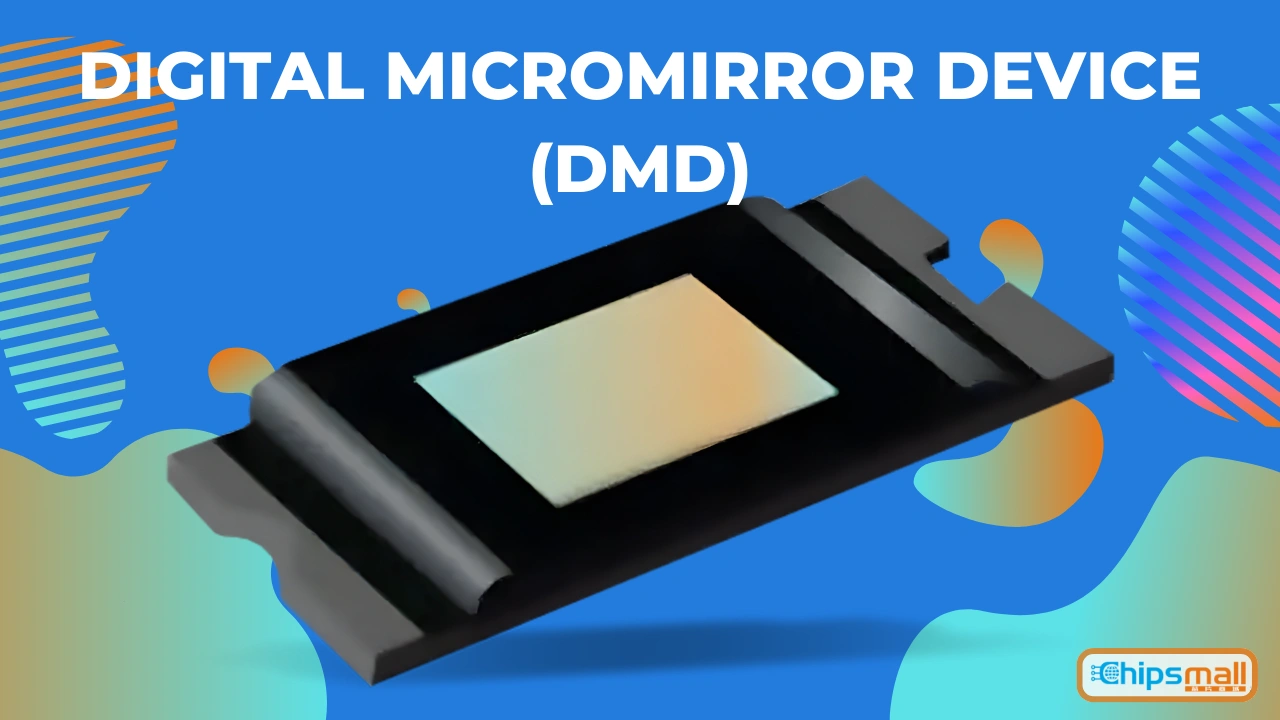
A Digital Micromirror Device (DMD) is a tiny chip that contains an array of small mirrors. Each mirror can tilt back and forth thousands of times per second. The mirrors represent pixels, small dots that together make up the final image you see on a screen.
The DMD was invented by Texas Instruments (TI) and is the core part of Digital Light Processing (DLP) technology. Its design allows light to be controlled very quickly and precisely, which is essential for high‑quality images.
Before DMDs, most displays used LCD or CRT screens. These screens were not very bright. The images were sometimes blurry. They also used a lot of energy.
In the early 1990s, engineers at Texas Instruments made the Digital Micromirror Device. This device could make pictures directly from digital signals. It worked in a new and better way.
The first scientific paper about the DMD came out in 1994 in the Journal of Vacuum Science & Technology B. It showed how millions of tiny mirrors could make clear, bright images on a screen.
Since then, DMDs have become faster and sharper. Now, they are used not only in projectors but also in 3D printers, microscopes, and other devices. They are very good at controlling light.
To understand how a DMD works, let’s break it down into steps.
The Mirror Array: A DMD chip is made up of millions of tiny mirrors arranged in a grid. Each mirror represents a single pixel in the final image. Some DMDs have resolutions like 768 by 576, which means there are 768 mirrors across and 576 mirrors down. More advanced models can go up to 2048 by 1152 or even higher. Each mirror is extremely small, only a few micrometers wide, which is one-millionth of a meter. These mirrors are made of aluminum and are mounted on tiny hinges that allow them to tilt.
Tilting Mirrors: Each mirror on a DMD can tilt in two directions. When a mirror is in the “on” position, it tilts so that light reflects toward the screen. When it is in the “off” position, it tilts so that the light goes away from the screen. By changing these tilt positions very quickly, the DMD can control how much light reaches each pixel on the screen.
Binary Light Control and Grayscale: Each mirror can only be fully on or fully off, which is called binary control. Even though the mirrors are only on or off, the DMD can create shades of gray and full-color images. This happens through rapid switching. The mirrors tilt thousands of times per second, and each video frame contains many mirror changes. The longer a mirror stays in the “on” position during a video frame, the brighter that pixel appears. The human eye blends these quick flashes, creating a smooth image with different brightness levels. This method is called pulse-width modulation, and it allows the DMD to make gray levels even though each mirror can only switch between on and off.
Each mirror on a DMD sits on a tiny hinge. Beneath the mirror is a small electronic circuit called a CMOS memory cell. CMOS stands for Complementary Metal‑Oxide‑Semiconductor, which is a common type of chip used in electronics.
The memory cell stores a single bit of information, either a 1 or a 0. If the cell stores a 1, the mirror tilts to the “on” position so that it reflects light toward the screen. If the cell stores a 0, the mirror tilts to the “off” position and reflects light away from the screen. Tiny electrostatic forces pull the mirror to the correct angle and keep it in that position until the memory cell changes.
These mirrors can flip thousands of times every second. This very high speed makes the projected images appear smooth, bright, and continuous to the human eye.
Making a DMD is complex because it combines mechanical parts with electronic circuits; that’s why it’s called a MEMS device.
CMOS Base Layer: First, engineers build a CMOS layer. This layer contains the electronic circuits that control each mirror.
Mirror Layer: After the CMOS layer is complete, engineers build the micromirrors on top. These mirrors are made of aluminum and connected to tiny hinges.
Final Assembly: Once the mirrors are placed, the whole device is sealed to protect the tiny moving parts from dust or damage.
Why this Matters: Because the mirrors and circuits are so small, fabrication requires special tools and clean rooms. The final product is a solid chip that can be integrated into many different machines.
A DMD chip by itself cannot make a visible image. It needs a complete optical system that includes a light source, lenses, and sometimes filters to project images onto a screen.
Light Source: The light source provides the illumination needed for the image. It can be a bright lamp, an LED, or a laser. The light shines toward the DMD so the mirrors can control where it goes.
Optics: Lenses and mirrors guide the light from the source to the DMD chip. They make sure the light hits the mirrors at the correct angle and spreads evenly across the chip.
DMD Chip: The DMD chip contains millions of tiny mirrors. These mirrors tilt to either reflect light into the projection path or away from it. By switching very quickly, the mirrors control how bright each pixel appears on the screen.
Projection Lens: The projection lens collects the light reflected by the DMD and focuses it onto a screen. This lens ensures that the image is sharp, clear, and correctly sized.
Viewer: Finally, the viewer sees the projected image on the screen or surface. Because the mirrors can move thousands of times per second, the image appears smooth and bright, even for fast-moving videos.
DMDs have several features that make them special and useful in many applications.
High Speed: The tiny mirrors on a DMD can flip thousands of times every second. This makes the images look smooth and natural, even when there is fast motion on the screen.
High Contrast: DMDs reflect light very well. Bright areas appear very bright, and dark areas stay very dark. This makes images sharp and clear.
High Reliability: The mirrors are designed to last for millions of flips. This means the DMD can work for a long time without breaking.
Wide Range of Light: DMDs can work with many types of light. They can use light from ultraviolet (UV) to infrared (IR), depending on what the application needs.
Digital Control: Each mirror is controlled by digital memory. This allows the DMD to work very precisely with digital video, computers, and other devices.
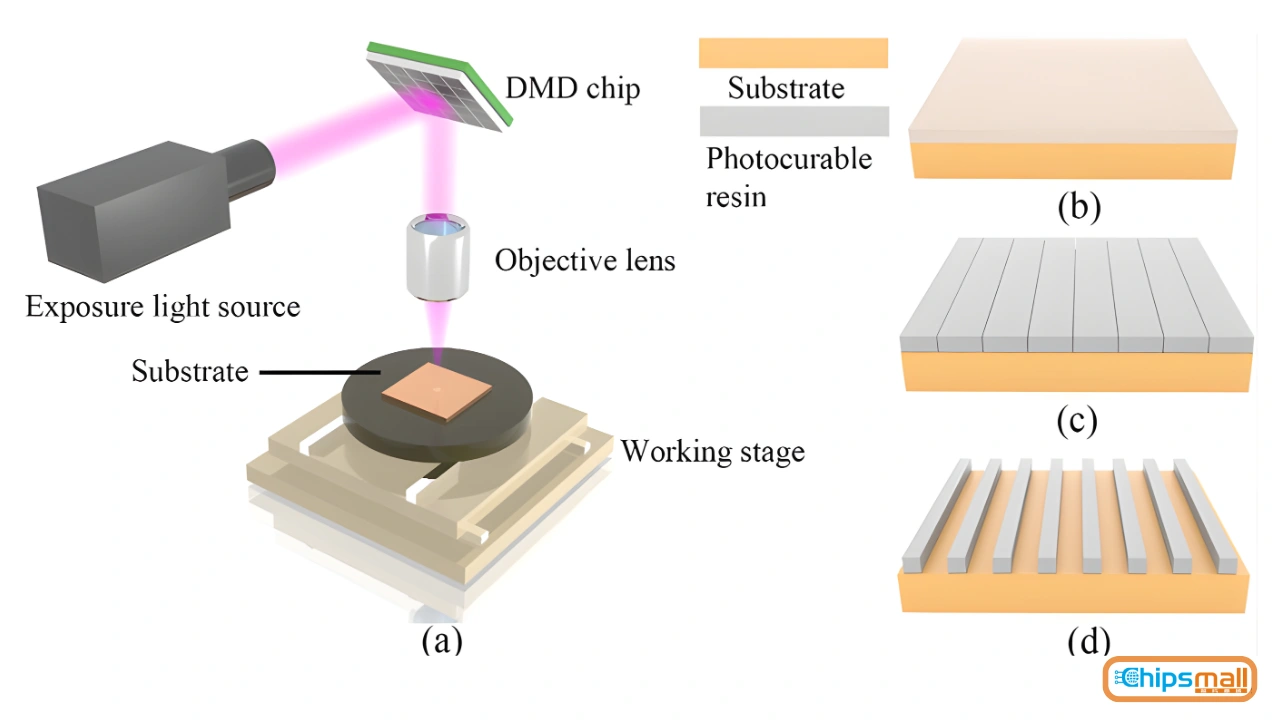
DMDs are used in many areas beyond just projector screens. They are very versatile because they can control light precisely and quickly.
Projection Displays: Projection displays are the most common use of DMDs. DMD projectors are known for great color quality, strong brightness, long lamp life, and low maintenance.
Home Projectors: Many modern home theater projectors use DMD chips. They create bright and sharp images on large screens, making movies and videos look clear and colorful.
Business and Classroom Projectors: DMDs are used in projectors for presentations in offices and classrooms. They work well in well-lit rooms and provide reliable brightness.
Cinema Projectors: Some digital cinema projectors use high-resolution DMDs to show movies on giant screens. They produce vivid images with smooth motion.
3D Printing: In some types of 3D printing, like stereolithography (SLA), DMDs help shape light patterns that harden liquid resin. A pool of liquid resin sits below a layer. The DMD shows a pattern of light that solidifies the resin in that shape. Then a new layer of resin is added, and the process repeats. Because each mirror controls a tiny part of the pattern, DMDs can create very fine and detailed 3D objects.
Structured Light Scanning: DMDs are used in 3D scanning to map real objects. A pattern of light is projected onto the object, and the DMD creates this pattern. Cameras capture how the pattern changes over the surface, and software uses this data to build a 3D model. This method is used in industrial inspection, cultural heritage modeling, and motion capture for films or games.
Microscopy: Advanced microscopes use DMDs for precise light control. For example, in confocal microscopy, only certain areas are illuminated. The DMD can switch the light on exactly where it is needed, which improves image quality and speeds up imaging.
Spectroscopy and Scientific Research: In spectroscopy, scientists study how light interacts with different materials. A DMD can select which wavelengths of light reach a detector. This helps in chemical analysis, material studies, and environmental sensing. Because the mirrors can switch very quickly, DMDs allow fast and detailed measurements.
Optical Communication and Displays: Some advanced communication systems use light to send data. DMDs can help switch and direct these light signals. In certain displays, including heads-up displays (HUDs), DMDs help form images that are bright, sharp, and easy to see even in daylight.
|
Feature / Comparison |
LCD (Liquid Crystal Display) |
OLED |
DMD (Digital Micromirror Device) |
|
How it works |
Lets light pass through pixels |
Each pixel emits its own light |
Reflects light using tiny mirrors |
|
Brightness |
Often less bright; light is blocked by filters |
Bright with good contrast but expensive |
Very bright due to efficient light reflection |
|
Contrast |
Moderate |
Excellent |
High |
|
Speed / Switching |
Moderate |
Fast |
Very fast mirror |
|
Reliability |
Moderate |
Can degrade over time |
Very reliable |
|
Best for |
Monitors and TVs |
High-end displays |
Projectors and large screens |
A DMD chip is black and white. The tiny mirrors can only control how much light is reflected. They do not create color on their own. To show full-color images, DMD systems use special methods to add color to the light.
Color Wheel: One common method is a color wheel. This is a spinning wheel with red, green, and blue filters placed in front of the light source. As the wheel spins, light passes through one color at a time. The DMD reflects this colored light toward the screen. Because the colors change very fast, the human eye blends them together and sees a full-color image.
Multiple DMD Chips: Some high-end projectors use three DMD chips. One chip is used for red light, one for green light, and one for blue light. The light from all three chips is combined to create a full-color image. This method gives very high image quality, but it is more expensive and complex.
LED and Laser Light Sources: Modern projectors often use LEDs or lasers instead of traditional lamps. These light sources can turn colors on and off very quickly. When used with a DMD, they provide accurate color control, high brightness, and better efficiency. LEDs and lasers also last longer and use less power.
When comparing different DMD systems, there are a few important points to understand. These factors help explain how good the image will look.
Resolution: Resolution means the number of mirrors, or pixels, on the DMD chip. More mirrors mean more detail. Higher resolution gives sharper and clearer images.
Refresh Rate: Refresh rate shows how many times the image updates each second. A higher refresh rate makes motion look smoother, especially in videos and fast-moving scenes.
Contrast Ratio: Contrast ratio is the difference between the brightest white and the darkest black. A higher contrast ratio makes images look deeper and more realistic.
Brightness: Brightness is measured in lumens. Higher brightness is needed for large rooms or bright environments. Lower brightness works well in dark rooms.
Color Accuracy: Color accuracy shows how close the colors on the screen look to real-life colors. Better color accuracy makes images look natural and pleasing to the eye.
No technology is perfect. DMDs have a few challenges:
Mechanical Movement: Mirrors are tiny mechanical parts. They can wear over long periods.
Complex Fabrication: Producing DMDs requires advanced manufacturing.
Color Artifacts: Older color wheel systems can produce color breakup (rainbow effect).
Cost: High‑end DMD projectors can be expensive.
DMDs continue to evolve:
Higher Resolution Chips: Future DMDs will have even more mirrors, giving better detail.
Faster Switching: Better speed improves motion clarity in video.
Laser Lighting: Lasers provide brighter, more efficient light sources.
New Applications: The flexibility of digital control makes DMDs useful in many fields beyond displays. DMDs may spread into:
Automotive sensing
Medical imaging
Quantum computing
Adaptive optics in telescopes
Digital Micromirror Devices may be very small, but their impact is huge. By using millions of tiny mirrors that move at high speed, a DMD can control light with great accuracy. That is why DMD technology is trusted in projectors, 3D printing, scientific tools, and many advanced imaging systems.
As technology continues to grow, DMDs are becoming faster, more powerful, and more flexible. Their ability to work with different light sources and handle complex tasks makes them valuable for both everyday use and advanced research.
QNo. 1: Why are DMD mirrors made so small?
Ans: The mirrors are very small so millions of them can fit on one chip. This allows the DMD to create detailed images with high resolution while keeping the device compact.
QNo. 2: Can a DMD work with both visible and invisible light?
Ans: Yes, a DMD can work with different types of light. Depending on its design, it can control ultraviolet, visible, and infrared light, which makes it useful for scientific and industrial work.
QNo. 3: Does a DMD create images by itself?
Ans: No, a DMD does not create light on its own. It only controls and reflects light from a source such as a lamp, LED, or laser to form images.
QNo. 4: What happens if one mirror on a DMD stops working?
Ans: If a mirror stops working, it may appear as a tiny dark or bright spot in the image. However, because a DMD has millions of mirrors, one faulty mirror usually does not affect overall image quality.
QNo. 5: Why are DMDs important in scientific research?
Ans: DMDs allow scientists to control light very precisely and very fast. This helps in experiments that need accurate light patterns, quick measurements, and detailed imaging results

Disclaimer: The views and opinions expressed by individual authors or forum participants on this website do not represent the views and opinions of Chipsmall, nor do they represent Chipsmall's official policy.

share this blog to:


Chipsmall will provide you real-time product updates, limited-time deals.


Copyright © 2004-2026 Chipsmall.com All Rights Reserved.

Feedback
We appreciate your engagement with Chipsmall's products and services. Your opinion matters to us! Kindly take a moment to complete the form below. Your valuable feedback ensures that we consistently deliver the exceptional service you deserve. Thank you for being part of our journey towards excellence.